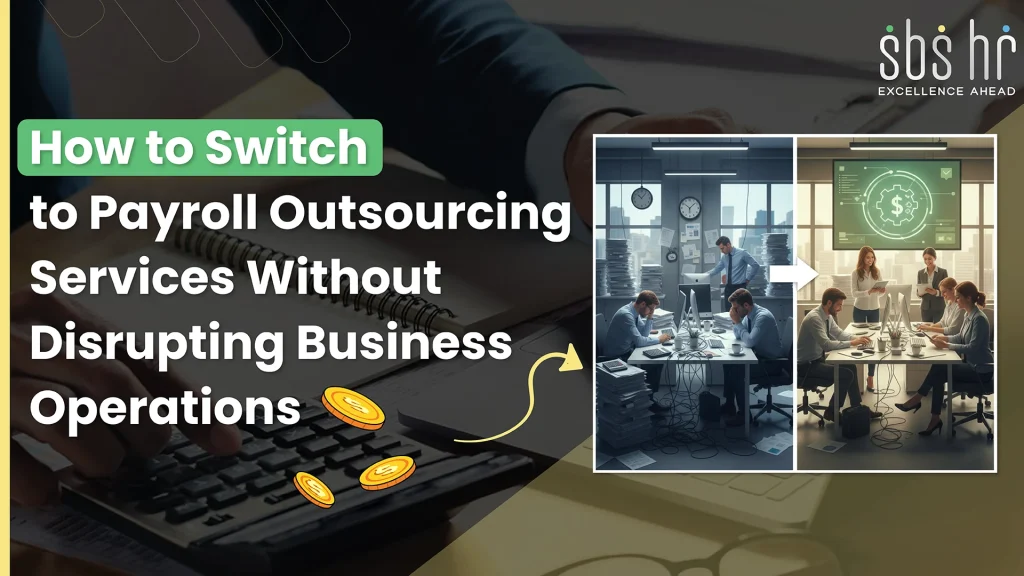
A single payroll mistake can ripple across your organization — affecting employee trust, compliance, and credibility. Studies show that nearly 20% of SMEs face penalties each year due to payroll errors or delays.
That’s why more organizations today are switching to payroll outsourcing services — not just to cut costs, but to gain accuracy, compliance confidence, and freedom for HR teams to focus on strategy.
Yet, transitioning from in-house payroll to a managed payroll provider requires careful planning to prevent disruptions in employee pay, data integrity, and internal coordination.
Here’s a comprehensive step-by-step guide to make that switch smooth and successful.
Step 1: Define Clear Objectives and Scope
Before making the move, define why you’re outsourcing and what exactly you will outsource.
Ask yourself:
- Will you outsource the entire payroll process — from calculations and tax filings to disbursements?
- Or just specific modules such as tax compliance or year-end filings?
- Do you want to include time and attendance integration, HRMS sync, or reporting automation?
- Which processes will remain in-house?
Clarity here ensures both your internal team and your payroll outsourcing provider share aligned expectations from day one.
Step 2: Select a Trusted Managed Payroll Outsourcing Service Provider
The success of your transition depends on choosing the right partner. Evaluate potential providers based on these key factors:
- Experience and Reputation – Prefer vendors with a strong presence in your industry and region.
- Comprehensive Service Offerings – Ensure they cover payroll, tax filings, benefits, and compliance.
- Technology Integration – The provider should integrate easily with your existing HRMS software and time-and-attendance systems.
- Data Security and Compliance – Check for adherence to GDPR, ISO, and local data protection regulations.
- Scalability and Flexibility – Choose a partner that can support future growth, regional expansion, or workforce changes.
- Support and Responsiveness – During rollout, you’ll need real-time support and escalation mechanisms.
Request demos, client references, and case studies to validate the provider’s credibility before finalizing.
Step 3: Audit, Cleanse, and Prepare Your Payroll Data
Carrying over inconsistent or incomplete payroll data is one of the most common transition pitfalls. Before migration:
- Reconcile historical pay records and statutory filings.
- Clean anomalies — duplicate entries, missing employee codes, or wrong tax identifiers.
- Standardize employee IDs, pay codes, and tax categories.
- Archive obsolete data while adhering to record-retention laws.
This cleanup ensures the new system runs smoothly and that data migration doesn’t create payroll errors.
Step 4: Map Integration Points with HRMS and Time Systems
Payroll doesn’t operate in isolation — it connects HR, attendance, and finance data.
To ensure flawless integration:
- Document data flow between your HRMS, time-tracking, and payroll systems.
- Define the source of truth for employee, attendance, and deduction data.
- Verify your provider can integrate through APIs or secure data transfers.
- Conduct prototype runs to validate real-time syncing and reconciliation.
Mapping integrations beforehand prevents manual adjustments and calculation mismatches later.
Step 5: Test and Validate with Parallel Payroll Runs
Before the official go-live, conduct parallel runs for at least 1–2 payroll cycles:
- Use identical input data in both old and new systems.
- Compare gross pay, net pay, deductions, and taxes for accuracy.
- Validate benefits, statutory contributions, and tax calculations.
- Involve your HR, finance, and audit teams for review.
This dual-run phase acts as a safety net — identifying and correcting discrepancies before full implementation.
Step 6: Communicate Clearly with Stakeholders
Transition disruptions often stem from poor communication, not technical issues.
- Inform employees in advance about new payroll timelines and FAQs.
- Set up a dedicated contact or helpdesk for queries.
- Train internal HR and finance teams on updated workflows.
- Coordinate with banks, benefits providers, and tax authorities early.
- Appoint “change champions” within each department to ease adoption.
Clear and transparent communication minimizes confusion and resistance.
Step 7: Establish a Transition Roadmap and Go-Live Plan
A successful payroll switch needs a structured roadmap. Break it into phases:
- Pre-Migration: Data cleansing, process mapping, and vendor onboarding.
- Testing & Parallel Runs: Verification and calibration of calculations.
- Cutover: Stopping the old system and triggering the new one.
- Post-Launch Monitoring: Reviewing outcomes and resolving early-cycle issues.
Include buffer time, rollback plans, and contingency procedures (like manual payroll fallback) during the initial cycles after go-live.
Step 8: Continuously Audit and Optimize
The work doesn’t end after implementation. Continuous evaluation ensures ongoing accuracy and compliance:
- Schedule periodic payroll audits.
- Track discrepancies between forecasts and actuals.
- Monitor employee pay-related queries and resolution time.
- Review vendor SLAs and performance metrics.
- Refine workflows to reduce manual intervention.
Regular performance reviews help your organization evolve into a data-driven payroll function.
Step 9: Leverage Automation and Analytics
One of the biggest advantages of outsourcing is access to cutting-edge payroll technology.
- Use dashboards to track trends, employee costs, and compliance status.
- Leverage HRMS-integrated reports for unified HR-payroll insights.
- Automate repetitive processes — statutory reporting, tax submissions, and payslip distribution.
- Use analytics from time and attendance software to monitor absenteeism or overtime costs.
When configured right, payroll outsourcing transforms your payroll from an administrative task into a strategic advantage.
Final Thoughts
Switching to payroll outsourcing services can unlock transformative efficiency, compliance accuracy, and scalability — provided you plan the transition carefully. The key lies in selecting the right managed payroll provider, integrating seamlessly with your HRMS software, and maintaining continuous oversight post-implementation.
At SBS HR, we’ve guided organizations across BFSI, manufacturing, and FMCG sectors through successful payroll transitions — achieving 100% compliance and zero payroll delays. Our partnerships with Keka, Greytip, Zoho, Adrenalin, and Mynd ensure smooth integration and reliable automation tailored to your business needs.
💼 Ready to make your payroll seamless and stress-free?
👉 Talk to SBS HR today and discover how to switch to managed payroll services — without disrupting your operations.