Introduction
India is entering a new era of labour reform. With the Labour Codes officially coming into force on 21 November 2025, businesses must prepare for major structural and compliance changes. These reforms consolidate 29 labour laws into four simplified, modern codes, aiming to bring clarity, uniformity, and improved employee welfare.
In this blog, we break down the major changes under each L’abour Code—Wages, Social Security, OSHWC (Occupational Safety), and Industrial Relations—and explain what employers need to do to stay compliant.
1. Code on Wages, 2019 – Uniformity in Salary Structure
The Code on Wages introduces a consistent definition of “wages” and changes the way salaries must be structured. This will impact payroll, CTC planning, and employee benefits.
Key Changes:
✔ Standard Definition of Wages
Earlier, different Acts used different definitions.
Now, a uniform definition applies.
Most importantly, allowances cannot exceed 50% of total wages.
This means:
Basic Salary + DA must be at least 50% of total compensation.
✔ Minimum Wages Must Include Basic + DA
Minimum Wage compliance will now be calculated only using Basic + DA (HRA excluded).
✔ Wider Applicability
Earlier, some provisions applied only to employees earning below ₹24,000. Now, the Code applies to all employees, regardless of salary.
✔ Bonus Ceiling Continued
Bonus eligibility ceiling (₹21,000 wages) will continue until further notification.
✔ Registers for All Employees
Companies must maintain wage and attendance registers for every employee, not just eligible categories.
Impact for Employers
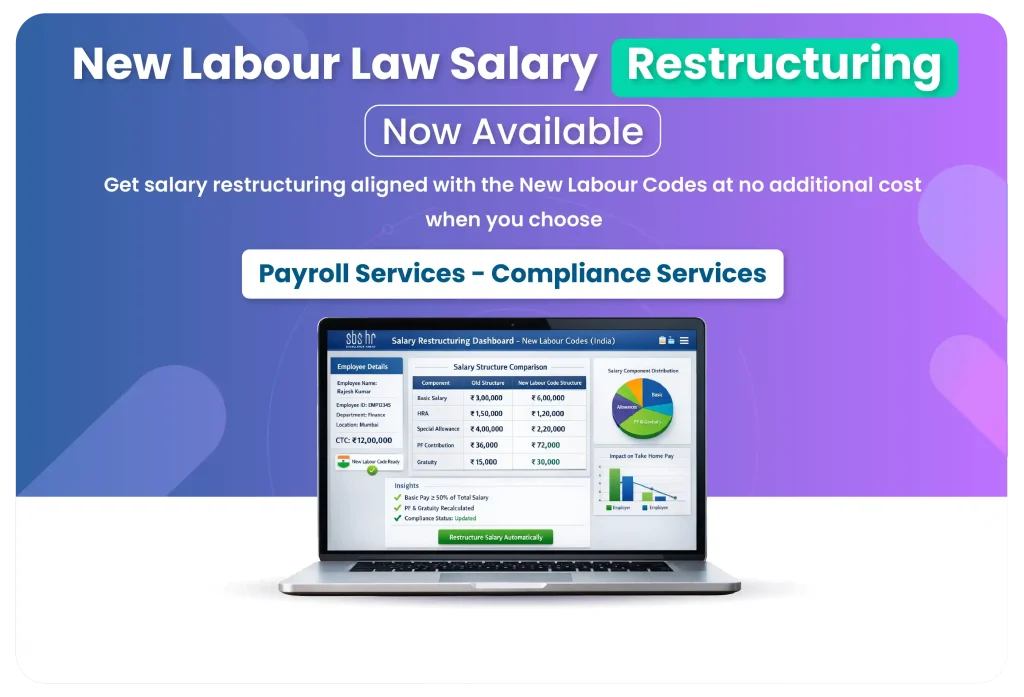
Restructure salary to maintain 50:50 ratio.
Higher Basic means higher PF contribution and increased employer cost.
Payroll software updates are mandatory.
2. Code on Social Security, 2020 – Expanded Protection
This Code aims to bring gig workers, unorganized workers, and fixed-term employees under social benefits.
Key Changes:
✔ PF & ESI Continue Under Existing Schemes
Since new schemes are not notified yet:
- PF continues under the current PF Act.
- ESI scheme will continue as-is until 20 Nov 2026.
✔ crèche Facility Requirement Changed
A common crèche becomes mandatory for establishments with 50 or more women employees, irrespective of ESI coverage.
✔ Gratuity for Fixed-Term Employees
Fixed-term employees become eligible for gratuity after completing just 1 year, instead of 5.
✔ More Sectors Under Central Govt
For sectors like Telecom, Banking, and Insurance, the Central Government becomes the “Appropriate Authority”.
Impact for Employers
- Re-evaluate crèche facility arrangements.
- Update policy for fixed-term worker benefits.
- Maintain database of workers for future social security schemes.
3. OSHWC Code, 2020 – Safety, Working Conditions & Compliance Tightened
The Occupational Safety, Health & Working Conditions Code focuses on improving workplace health and safety.
Key Changes:
✔ Appointment Orders for All
Every employee—including contract labour—must receive an Appointment Order.
✔ Factory Threshold Increased
Factory definition changes to:
- 20 workers with power (earlier 10)
- 40 without power (earlier 20)
This reduces compliance burden for small units.
✔ Contract Labour Applicability Updated
Contract Labour Act applicability threshold increases from 20 workers to 50 workers.
✔ Contract Labour Banned in Core Activities
Contract labour cannot be used for core business operations.
✔ Increased Welfare Responsibilities for Employer
Principal Employer (PE) is responsible for:
- Canteen (mandatory at 100 workers, earlier 250)
- Welfare Officer (mandatory at 250 workers, earlier 500)
- Safety Officer (mandatory at 500 workers, earlier 1000)
✔ Annual Leave Eligibility Reduced
Employees become eligible after 180 days, not 240.
Impact for Employers
- Issue appointment letters universally.
- Revise contracts with manpower agencies.
- Assess if core activities involve contract labour.
Prepare for additional welfare infrastructure.
4. Industrial Relations Code, 2020 – Redefining Employer-Employee Relations
The Industrial Relations Code modernizes HR processes related to discipline, disputes, and layoffs.
Key Changes:
✔ Clear Definition of Industry & Supervisor
Supervisor earning more than ₹18,000 is not considered a worker.
✔ Stricter Rules for Strikes
- 60-day prior notice required.
- 50% workers taking mass casual leave counts as a Strike.
✔ Grievance Redressal Committee Expanded
Committee size increases from 6 to 10 members.
✔ Threshold for Govt Approval in Layoffs Increased
Permission required for layoffs only when establishment has 300+ workers (earlier 100+).
✔ Time Limits Reduced for Filing Disputes
- Grievance filing: 1 year (earlier 3 years)
- Industrial dispute: 2 years (earlier 3 years)
✔ Reskilling Fund Introduced
Employer must contribute 15 days’ wages for every retrenched worker.
Impact for Employers
- Update Standing Orders (now applicable to 300+ workers).
- Create structured HR policies for discipline and dispute resolution.
Prepare documentation for layoffs & retrenchment.
Overall Conclusion
With the Labour Codes becoming effective from 21 November 2025, employers must immediately implement all direct provisions of these Codes. However, since procedural rules are yet to be notified by Central and State Governments, all procedural compliance will continue under existing labour laws.
What Employers Must Do Now
- Review HR policies, contracts, and salary structures.
- Update payroll systems as per wage definition.
- Train HR and compliance teams on new requirements.
- Prepare for increased documentation and record-keeping.
- Coordinate with legal and compliance experts for a smooth transition.
✔ Need Support Adapting to the New Labour Codes?
SBS HR helps your organisation stay fully compliant with all four labour codes—eliminating confusion, simplifying processes, and reducing compliance risks.
From revising payroll structures to updating internal policies and managing complete statutory requirements, we provide expert guidance at every stage.
🔹Be Compliant. Be Confident. Choose SBS HR as your compliance partner.

- Payroll OutsourcingPayroll Outsourcing
- Talent AcquisitionTalent Acquisition
- Statutory ComplianceStatutory Compliance
- Global PEO | EOR ServicesGlobal PEO | EOR Services
- Our BlogOur Blog
- HR TemplatesHR Templates
- SitemapSitemap
- About UsAbout Us
- Contact UsContact Us
- Find JobsFind Jobs
- CSRCSR
-
Sales Enquiry: +91 89259 27076
-
For Job Enquiry: +91 82486 03617
-
For Sales Enquiry: sales@sbshr.com
-
For Job Enquiry: talentacquisition@sbshr.com

Our Services
- Payroll OutsourcingPayroll Outsourcing
- Talent AcquisitionTalent Acquisition
- Statutory ComplianceStatutory Compliance
- Global PEO | EOR ServicesGlobal PEO | EOR Services
Company
- About UsAbout Us
- Contact UsContact Us
- Find JobsFind Jobs
- CSRCSR
Resources
- Our BlogOur Blog
- HR TemplatesHR Templates
- SitemapSitemap
Talk to Sales
-
+91 89259 27076
-
sales@sbshr.com
For Candidates
-
+91 82486 03617
-
talentacquisition@sbshr.com