The Friday–Monday puzzle every HR manager knows
It is Thursday afternoon. Your inbox pings: Priya wants Friday and the following Monday off. Ten minutes later, Rahul asks for the same two days. By evening, a third of the sales team has quietly built themselves a four-day weekend out of two days of leave.
Nobody broke a rule. Yet Monday morning, the client call has no one on it, the dispatch is late, and your operations head wants to know why “half the floor was on holiday.”
This is the exact problem the sandwich leave policy was invented to solve. It is also one of the most misunderstood, most complained-about and most often legally careless policies in Indian HR. Done well, it protects continuity. Done badly, it reads to employees like a hidden tax on their leave balance.
This guide shows you how to build a sandwich leave policy that land on the right side of that line.
What is sandwich leave policy?
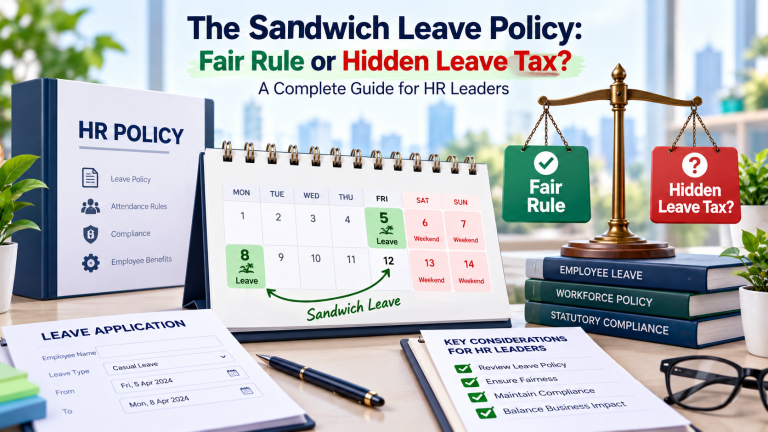
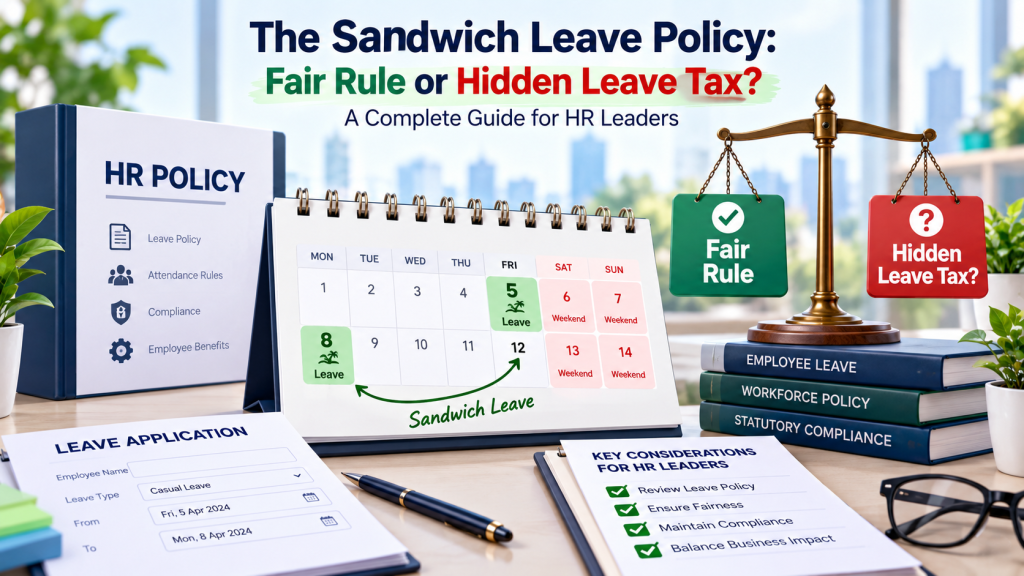
Under a sandwich leave policy, any weekend or holiday that falls between two days of leave is counted as leave too. The non-working days are the “filling”; the leave days on either side are the “bread.”
The logic is simple: if an employee is away continuously, the company treats the whole stretch as one leave period, not as two separate days with free days in the middle.
Here is how it plays out in practice:
| Scenario | Days applied | Without sandwich rule | With sandwich rule |
| Leave on Friday and Monday | 2 | 2 days debited | 4 days debited (Sat and Sun added) |
| Leave on Friday only | 1 | 1 day debited | 1 day debited |
| Leave Thursday, holiday Friday, leave Monday | 2 | 2 days debited | 5 days debited (Fri, Sat, Sun added) |
| Leave Monday to Friday | 5 | 5 days debited | 5 days debited (weekends at either end are not “sandwiched”) |
| Leave on day before and day after Diwali | 2 | 2 days debited | 3 days debited (Diwali added) |
Notice the pattern: the rule only bites when leave sits on both sides of a non-working day. A single Friday or a single Monday off is never sandwiched.
That one detail is where most confusion about a sandwich leave policy, and most employee frustration, begins.
Is sandwich leave policy legal in India?
Short answer: It depends on who your employee is and which type of leave you apply it to. No Indian law creates a “sandwich rule.” It is a company policy, so it must sit inside the limits that labour law already sets.
Factory workers: The rule cannot touch statutory annual leave. Section 79 of the Factories Act, 1948 says annual leave with wages must be exclusive of all holidays, whether they fall during the leave or at either end of it. In plain terms, if a factory worker takes earned leave on Friday and Monday, you cannot debit the weekend or a holiday in between from their statutory leave. Applying a sandwich rule here exposes the employer to a compliance violation.
Shops and commercial establishments: check your state Act. Offices, IT companies, retail and service businesses are governed by each state’s Shops and Establishments Act. These Acts set minimum leave entitlements but generally do not spell out how intervening holidays are counted. That gap is why many corporates apply the sandwich rule. It is not a licence to cut below the statutory minimum, though: if the rule effectively reduces an employee’s leave below what the state Act guarantees, it is open to challenge.
Contracts and standing orders matter. Where Industrial Employment (Standing Orders) apply, or an appointment letter defines leave counting, your policy must match those documents. A rule that appears only in an HR email is hard to defend.
The practical takeaway: apply the sandwich rule, if at all, to company-granted leave above the statutory minimum, never to statutory annual leave for factory workers. As the new labour codes are implemented, review the equivalent provisions before your next policy update.
Sources: Factories Act, 1948, Section 79 (Indian Kanoon); Abstract of the Factories Act (Delhi Labour Department).
The case for and against
Sandwich leave policy divides HR teams for good reason. Both sides have a point.
| Why employers use it | Why employees push back | |
| Business continuity | Stops mass absences around weekends and festivals | Feels like punishment for planning a break |
| Fairness | Treats one continuous absence as one leave period | Charges leave for days the office was closed anyway |
| Leave balance | Slows misuse of short leave to stretch weekends | Drains balances fast; a 2-day break can cost 4 days |
| Planning | Encourages longer, pre-planned leave over scattered days | Penalises genuine emergencies like a Friday illness and Monday follow-up |
| Employer brand | Signals discipline in high-attendance roles | Shows up in Glassdoor reviews as a “hidden leave tax” |
The honest verdict: sandwich leave policy works best in roles where coverage is critical, such as plants, customer support, logistics and retail. In knowledge roles where output matters more than presence, it often costs more in goodwill than it saves in attendance.
How to design a sandwich leave policy people will accept
The difference between a respected policy and a resented one is rarely the rule itself. It is how precisely you define it and how fairly you apply it. Six design choices decide the outcome:
- Define the scope. State exactly which leave types it applies to, such as casual or privilege leave. Exclude statutory annual leave for factory workers, maternity leave, and any leave your state Act protects.
- Set a trigger. Decide whether the rule applies only when leave sits on both sides of a non-working day, or also to half-days. Clear examples remove guesswork.
- Carve out emergencies. Exempt medical leave backed by a certificate, bereavement leave, and hospitalisation of a dependant. This one change removes most employee resentment.
- Allow pre-approved exceptions. Let managers waive the rule for leave applied, say, 30 days in advance. That rewards planning instead of penalising it.
- Put it in writing. Include the rule in the appointment letter and leave policy, and in standing orders where they apply. Get employee acknowledgement.
Automate the calculation. Configure the rule in your HRMS so every employee sees the true leave debit before they submit. No surprises at payroll time
Sample policy clause
Adapt this wording to your organisation and have it reviewed against your state’s laws before you adopt it:
Sandwich Leave. Where an employee takes [casual / privilege] leave on the working day immediately before and the working day immediately after a weekly off or a declared holiday, the intervening weekly off(s) and holiday(s) shall be counted as leave and debited from the employee’s leave balance.
This rule shall not apply to: (a) statutory annual leave under the Factories Act, 1948 or any law that excludes holidays from leave; (b) maternity, paternity or bereavement leave; (c) sick leave supported by a medical certificate; or (d) leave approved in writing at least [30] days in advance.
Leave taken on only one side of a weekly off or holiday shall not attract this rule. The HRMS shall display the total days to be debited at the time of application.
Five sandwich leave policy mistakes that turn a sensible rule into an HR headache
- One policy for every location and worker type. Applying the same rule to factory workers and office staff is the fastest route to a Factories Act violation.
- Silent deductions. Employees who discover the extra debit only on their payslip lose trust instantly. Show the calculation upfront.
- No exceptions for emergencies. Debiting four days from someone who was hospitalised over a weekend is legal in some cases, but it is never good HR.
- Inconsistent enforcement. If one manager waives the rule and another does not, you invite grievances and discrimination claims. Write down who can approve exceptions.
- Forgetting half-days. Decide in advance whether a half-day on Friday afternoon plus Monday triggers the rule. Ambiguity here causes most disputes.
The bottom line: keep the bread, rethink the filling
A sandwich leave policy is neither good nor bad on its own. Written narrowly, applied consistently and automated transparently, it protects coverage without eroding trust. Written loosely, it becomes a compliance risk and a talking point in every exit interview.
Before you publish your 2027 leave policy, ask three questions. Does it respect statutory leave? Does it carve out genuine emergencies? Can every employee see exactly how many days will be debited before they click “apply”?
If any answer is “not sure,” SBS HR can help. We review leave policies against state labour laws, handle payroll and statutory compliance for businesses in Chennai, Mumbai and across India, and configure leave rules in Zoho People and Keka so your sandwich policy calculates itself, correctly, every time.
Talk to SBS HR about a leave policy health check: sbshr.com.
Sources
Factories Act, 1948, Section 79: Annual leave with wages (Indian Kanoon)
Abstract of the Factories Act, 1948 and Delhi Factories Rules (Delhi Labour Department)