
POSH Compliance in India: How to Set Up Your Internal Committee, File the Annual Report and Avoid Penalties
POSH compliance is not a poster on the wall
Walk into most Indian offices and you’ll find it: a framed POSH policy near the pantry, a list of Internal Committee members with one name that left the company two years ago, and an external member nobody has spoken to since the last training.
On paper, the company is compliant. In reality, the first serious complaint will expose everything: a committee that isn’t validly constituted, an inquiry that crosses 90 days, an annual report that was never filed, and a board report that now has to disclose all of it.
POSH compliance is no longer a box-ticking exercise. Since July 2025, every company must publish its harassment complaint numbers in the Board’s report. District Officers are actively checking whether committees exist and reports are filed. And courts have repeatedly set aside inquiries run by improperly constituted committees.
This guide walks HR leaders through the three pillars of POSH compliance that matter most: setting up the Internal Committee correctly, filing the annual report on time, and understanding the penalties for getting it wrong.
Who needs POSH compliance, and what the law actually asks for
The Sexual Harassment of Women at Workplace (Prevention, Prohibition and Redressal) Act, 2013, known as the POSH Act, applies to every workplace in India: private companies, LLPs, startups, NGOs, hospitals, schools, shops and government offices alike.
Two numbers decide your obligations:
- 10 or more employees at an office or branch: you must constitute an Internal Committee (IC, often still called the ICC) at that location.
- Fewer than 10 employees: complaints go to the Local Committee set up by the District Officer, but your other POSH duties still apply.
“Employee” is read broadly. It covers permanent staff, contract and temporary workers, trainees, interns and apprentices. And an aggrieved woman need not be your employee at all: a visitor, client or vendor harassed at your workplace can also complain.
The employer’s core duties under Section 19
POSH compliance goes well beyond forming a committee. The Act requires every employer to:
- Provide a safe working environment, including protection from visitors and third parties.
- Display the consequences of sexual harassment and the order constituting the Internal Committee at a visible place.
- Run workshops and awareness programmes for employees, and orientation for committee members.
- Give the committee the facilities it needs to deal with complaints and conduct inquiries.
- Help secure the attendance of the respondent and witnesses.
- Assist the complainant if she chooses to file a police complaint.
- Treat sexual harassment as misconduct under service rules and act on the committee’s recommendations.
- Monitor the timely submission of reports by the committee.
POSH sits alongside your other labour law obligations. If you are tracking PF, ESI, PT and LWF filings as well, our statutory compliance services bring all of them onto one calendar.
Setting up the Internal Committee the right way
The Internal Committee is the backbone of POSH compliance. If it is not constituted exactly as Section 4 requires, any inquiry it conducts can be challenged and set aside, however careful the process was.
Who must sit on the committee
| Role | Who qualifies | Number |
|---|---|---|
| Presiding Officer | A woman employed at a senior level. If none is available at that office, one from another office or unit of the same employer | 1 |
| Internal members | Employees committed to the cause of women, or with experience in social work or legal knowledge | At least 2 |
| External member | A person from an NGO or association committed to the cause of women, or someone familiar with issues of sexual harassment | 1 |
At least half of all members must be women. Members hold office for a maximum of three years, and the external member is paid fees for attending proceedings.
Six setup steps HR should not skip
- Constitute by written order. Issue a formal order naming each member, their role and tenure, signed by an authorised signatory.
- One committee per location. Every office or branch with 10 or more employees needs its own committee, or a valid order extending one committee’s coverage across locations.
- Choose the external member carefully. Avoid anyone with a conflict of interest, and document their credentials.
- Display it. Put the committee’s names, contact details and the consequences of harassment on notice boards and the intranet.
- Train the committee. Members need orientation on inquiry procedure, natural justice and confidentiality before their first case.
- Track tenure and exits. Reconstitute immediately when a member leaves or their term ends. A lapsed committee is one of the most common audit findings.
Tip: Tie committee tenure to your HR system. When an IC member’s exit is processed in your HRMS, it should trigger a reconstitution task automatically, so the committee never lapses unnoticed.
What happens once a complaint is filed
Every stage of the process has a statutory deadline, and the 90-day inquiry window now appears in your Board’s report.
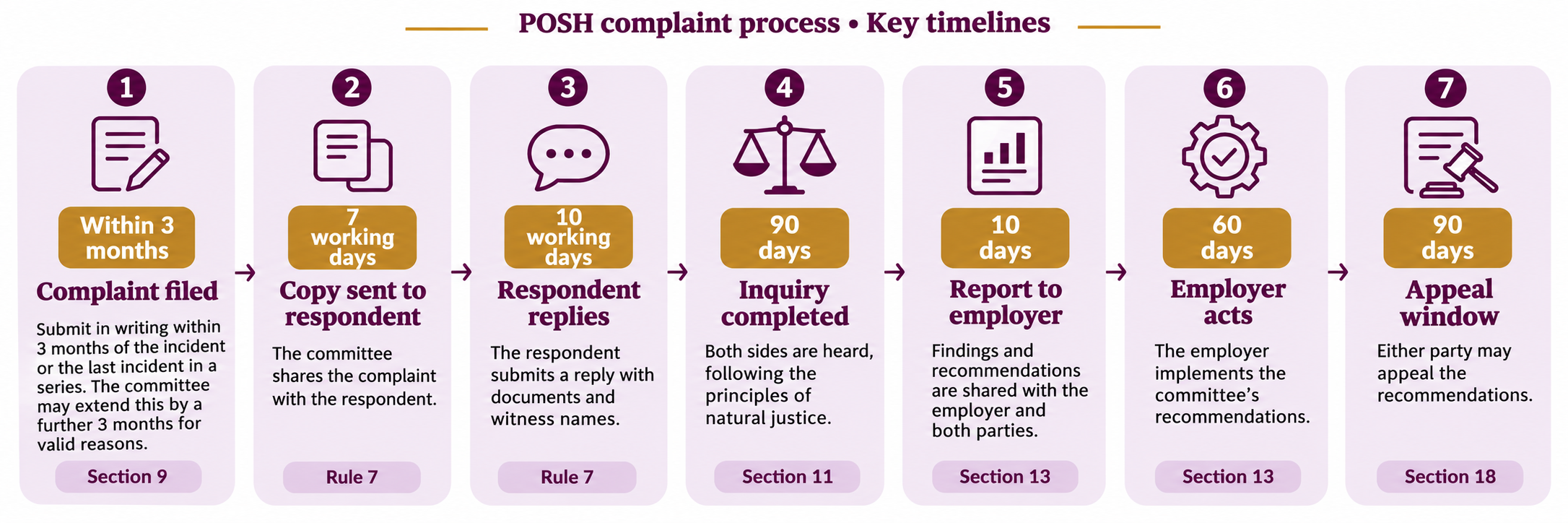
Conciliation is possible only if the complainant asks for it, and no monetary settlement can be its basis. If conciliation fails or is not requested, the inquiry must be completed within 90 days, with both sides given a fair hearing.
The annual report: the filing most employers forget
If the Internal Committee is the backbone of POSH compliance, the annual report is its proof of life. Under Section 21 of the Act and Rule 14 of the POSH Rules, the committee must prepare an annual report and submit it to the employer, who forwards it to the District Officer.
What the report must contain
- Number of sexual harassment complaints received during the year
- Number of complaints disposed of during the year
- Number of cases pending for more than 90 days
- Number of workshops or awareness programmes held
- Nature of action taken by the employer or District Officer
The report is due even if you received zero complaints. A nil report shows the committee exists and is functioning; a missing report suggests it doesn’t.
When it is due
The Act does not fix a single national date. POSH reporting follows the calendar year, and most District Officers expect the report by 31 January for the previous year. Some districts set their own deadline or format, so confirm the requirement for every district where you have an office. For calendar year 2026, plan to file by 31 January 2027.
The Board’s report: a new layer since July 2025
The Companies (Accounts) Second Amendment Rules, 2025, in force from 14 July 2025, made POSH compliance visible to shareholders. Every company’s Board’s report must now include:
| Disclosure | Source of the data |
|---|---|
| Statement that the Internal Committee has been constituted as required | Committee constitution order |
| Complaints received during the financial year | Committee records |
| Complaints disposed of during the financial year | Committee records |
| Cases pending for more than 90 days | Committee records |
| Number of female, male and transgender employees | HR master data |
| Statement of compliance with the Maternity Benefit Act, 1961 | HR policy and records |
Note the mismatch: the District Officer report follows the calendar year, while the Board’s report follows the financial year. HR should keep complaint data month by month so both reports can be produced from the same records. Gender-wise headcount comes straight from your employee master, which is why clean data in your payroll and HR records matters at board-report time.
Some district authorities also expect the committee to be registered on the government’s SHe-Box portal. Requirements are still evolving, so check with your District Officer.
Sources: Mondaq on the 2025 amendment; Khaitan & Co on MCA amendments; TaxGuru on POSH return due dates.
Penalties: what non-compliance really costs
The headline fine under the POSH Act looks modest. The real cost of weak POSH compliance is much larger once you add repeat penalties, Companies Act exposure and the litigation that follows a botched inquiry.
| Failure | Consequence |
|---|---|
| Not constituting an Internal Committee | Fine of up to Rs 50,000 under Section 26 |
| Not acting on committee or District Officer recommendations | Fine of up to Rs 50,000 |
| Not filing the annual report or not disclosing it as Section 22 requires | Fine of up to Rs 50,000 |
| Repeating any of these offences | Up to twice the earlier penalty, and possible cancellation, withdrawal or non-renewal of the business licence or registration |
| Missing POSH disclosures in the Board’s report | Penalty under Section 134(8) of the Companies Act on the company and on each officer in default |
| Breach of confidentiality by anyone handling a case | Penalty as per service rules under Section 17 |
What the courts have made clear
The bigger risk is not the fine but the collapse of a case. In Aureliano Fernandes v. State of Goa (2023), the Supreme Court set aside proceedings against an employee because the inquiry had failed basic procedural requirements, and it directed authorities to verify that committees are properly constituted across the country.
The lesson for HR is simple: a committee with the wrong composition, an inquiry that ignores natural justice, or a report that misses its deadline can undo months of work and expose the company to fresh claims from both the complainant and the respondent.
POSH compliance done properly protects the complainant, the accused and the company at the same time.
Your year-round POSH compliance checklist
Print it, assign an owner to each line, and review it every quarter.
Policy and committee
- A written POSH policy, approved by management, shared with every employee and available in the languages your workforce uses.
- An Internal Committee at every location with 10 or more employees, constituted by written order.
- Committee composition checked: senior woman Presiding Officer, at least two internal members, one external member, at least half women.
- Tenure tracker in place, with reconstitution triggered when any member leaves or completes three years.
Awareness and training
- Annual awareness sessions for all employees, including contract staff and interns.
- Separate orientation for committee members on inquiry procedure and confidentiality.
- Sensitisation for managers on how to respond when someone confides in them.
- Attendance records kept, because training counts are part of the annual report.
Complaints and inquiries
- A clear, confidential channel for complaints, including an email ID that reaches only the committee.
- Every complaint logged with dates for notice, reply, inquiry completion, report and employer action.
- Cases approaching 90 days flagged for escalation.
- Recommendations acted on within 60 days and documented.
Reporting
- Annual report filed with the District Officer for each district, usually by 31 January, nil reports included.
- Board’s report disclosures prepared for the financial year: committee statement, complaint numbers, gender-wise headcount and Maternity Benefit Act statement.
- Committee details updated on any portal your district requires.
Frequently asked questions
Is POSH compliance mandatory for small companies?
Yes. Every workplace is covered by the POSH Act. Employers with 10 or more employees at a location must set up an Internal Committee there; smaller workplaces rely on the Local Committee, but the other employer duties still apply.
Is it called ICC or IC?
The Act uses “Internal Committee.” Many organisations still say ICC (Internal Complaints Committee), and both refer to the same body.
Can the external member be a lawyer?
Yes, if they are associated with an NGO or association committed to the cause of women, or are familiar with issues relating to sexual harassment, and have no conflict of interest.
Do we need to file the annual report if there were no complaints?
Yes. A nil report is still required and shows the committee is functioning.
What is the deadline for the POSH annual report?
The Act does not fix one national date. Most District Officers expect it by 31 January for the previous calendar year, but confirm the date for each district.
What is the penalty for not having an Internal Committee?
A fine of up to Rs 50,000. Repeat offences can attract twice the penalty and the cancellation or non-renewal of the business licence or registration.
Does POSH compliance cover men who are harassed?
The Act protects women. Many employers choose a gender-neutral policy that covers all employees under their own service rules, while keeping the statutory process for complaints by women.
From poster to practice
Real POSH compliance isn’t measured by the policy on the wall. It is measured by what happens when someone finally finds the courage to complain: a committee that is validly constituted, an inquiry that is fair and on time, and an employer that acts on the outcome.
Get the three pillars right, a properly constituted Internal Committee, an annual report filed every January, and Board’s report disclosures that match your records, and the penalties in this guide will never apply to you.
Get a POSH compliance health check
If managing POSH compliance across locations feels like one more thing on an already full HR calendar, SBS HR can help. Our statutory compliance team supports businesses in Chennai, Mumbai and across India with compliance calendars, record-keeping and filings, so nothing slips between January and the next board meeting.