Payroll in India has never been harder to get right. The four Labour Codes came into force in November 2025, the Income-tax Act, 2025 replaced the 1961 Act from 1 April 2026, and states keep revising minimum wages twice a year. One wrong calculation can mean penalties, unhappy employees and hours of rework.
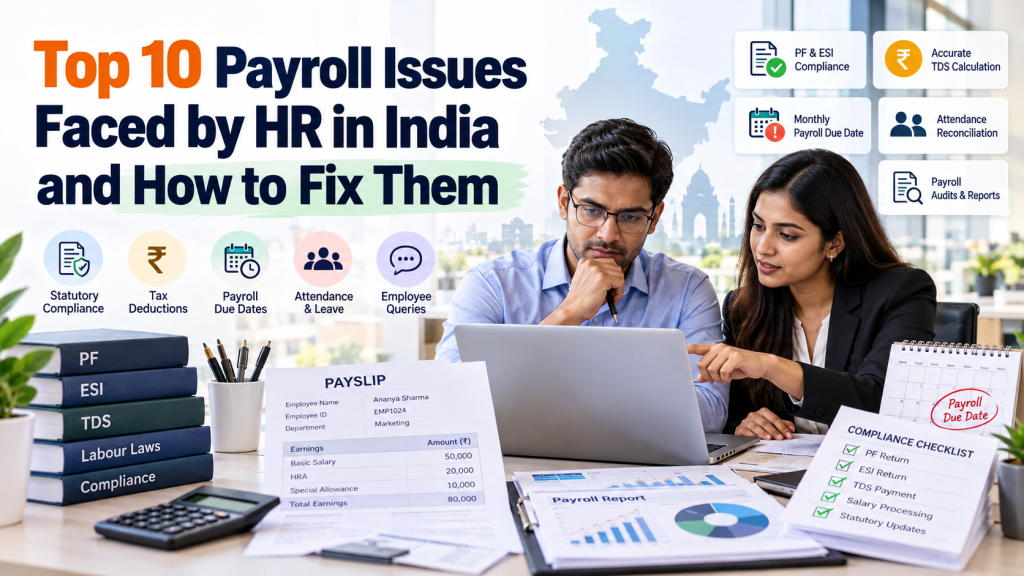
Below are the 10 most common payroll issues HR teams in India face today, along with practical steps to fix each one.
1. Labour Code Transition and Salary Restructuring
The Problem: Under the new Labour Codes, “wages” must be at least 50% of total remuneration. If allowances go above 50%, the excess is added back to wages. Many companies built their CTC with a low basic and high allowances, so their PF, gratuity and leave encashment costs now rise. State rules are still being finalised, which adds to the confusion.
How to fix it:
- Audit every salary structure against the 50% wage rule and identify the gaps.
- Restructure CTC so basic plus DA is at least 50%, and model the impact on take-home pay before rolling it out.
- Explain the changes to employees in simple terms. Higher PF means lower take-home but stronger retirement savings.
- Track state-level rule notifications for every location where you have employees.
2. New Income Tax Act and Tax Regime Confusion
The Problem: The Income-tax Act, 2025 came into effect on 1 April 2026, which changes section references, forms and declarations. On top of that, employees choose between the old and new tax regimes, often declare late or switch midway, and end up with heavy TDS deductions in January to March.
How to fix it:
- Update your payroll software and TDS templates to the new Act before the financial year starts.
- Collect each employee’s regime choice in April, and give them a simple calculator to compare both regimes.
- Project annual tax every month so TDS is spread evenly through the year.
- Run a mid-year tax review in October so there are no surprises in Q4.
3. State-wise Compliance and Minimum Wage Revisions
The Problem: Professional Tax, Labour Welfare Fund, Shops and Establishments rules and minimum wages are different in every state. A company with offices in Chennai and Mumbai follows two separate sets of rules. Most states also revise the Variable Dearness Allowance (VDA) twice a year, and missing a revision means paying below the legal minimum.
How to fix it:
- Maintain a state-wise compliance calendar covering PT slabs, LWF dates and minimum wage revisions.
- Map every employee to the correct state and skill category (unskilled, semi-skilled, skilled, highly skilled).
- Check minimum wage notifications every April and October and update pay before the effective date.
- Configure state rules in your payroll system instead of relying on manual adjustments.
4. Missed Statutory Due Dates and Penalties
The Problem: Payroll comes with a long list of monthly, quarterly and annual deadlines. A late PF or ESI payment attracts interest and damages, and late TDS deposits or returns lead to interest, late fees and notices.
| Compliance | Due date |
|---|---|
| PF and ESI contributions | 15th of the following month |
| TDS deposit on salaries | 7th of the following month (30 April for March) |
| Quarterly TDS return on salaries | 31 July, 31 October, 31 January, 31 May |
| Annual TDS certificate to employees | 15 June |
| Professional Tax | As per each state’s schedule |
How to fix it:
- Build a compliance calendar with reminders at least five days before every due date.
- Fix a payroll cutoff that leaves enough time to pay statutory dues after salaries are processed.
- Assign a clear owner and a backup for each filing.
- Keep challans and acknowledgements in one shared folder for audits.
5. Attendance Errors and Late Payroll Inputs
The Problem: Biometric data, shift rosters and leave approvals often don’t match. New joiners, exits, increments and incentives arrive after the cutoff date. The result is wrong loss-of-pay deductions, missed overtime, arrears and off-cycle payments.
How to fix it:
- Set a fixed monthly input cutoff (for example, the 20th) and share it with every manager.
- Integrate attendance and leave systems directly with payroll so data flows without re-entry.
- Ask managers to approve attendance and leave before the cutoff, not after.
- Run a variance report every month and review big changes in pay before final processing.
6. Full and Final Settlement Delays
The Problem: The Code on Wages requires final dues to be paid within two working days of an employee’s exit. In practice, notice period recovery, leave encashment, gratuity, bonus and asset clearance take weeks. Delays frustrate exiting employees and create legal exposure.
How to fix it:
- Start the clearance process as soon as the resignation is accepted, not on the last day.
- Use a standard F&F checklist covering IT assets, advances, leave balance and notice recovery.
- Pre-calculate gratuity and leave encashment during the notice period.
- Set a two-day F&F target and track every pending settlement weekly.
7. PF, ESI and Employee Query Overload
The Problem: HR spends hours on the same questions every month: “Why is my salary lower?”, “Why was so much tax deducted?”, “Why can’t I withdraw my PF?”. UAN-Aadhaar linking, KYC mismatches, PF transfers and ESI card issues add to the load. Collecting and verifying investment proofs every January to March is another major bottleneck.
How to fix it:
- Complete UAN, Aadhaar, PAN and bank KYC during onboarding itself.
- Give employees a self-service portal for payslips, tax computation, TDS certificates and proof uploads.
- Publish a simple payslip guide and a payroll FAQ.
- Open the investment proof window in December and verify submissions in batches.
8. Contract and Gig Workforce Compliance
The problem: As the principal employer, your company is liable if a contractor fails to pay wages, PF or ESI to its workers. The Code on Social Security also brings new obligations for gig and platform workers, and fixed-term employees now become eligible for gratuity after one year of service.
How to fix it:
- Collect monthly proof of wage payment, PF and ESI challans from every contractor before releasing their invoice.
- Add compliance and indemnity clauses to all contractor agreements.
- Identify which workers fall under gig, platform or fixed-term categories and track their entitlements separately.
- Audit contractor compliance at least once a quarter.
9. Manual Payroll, Weak Systems and Data Security
The Problem: Many SMEs still run payroll on Excel, with formula errors, multiple versions and no audit trail. Other companies use software that is slow to update for legal changes or doesn’t connect with their HRMS. Salary data is highly sensitive, and the Digital Personal Data Protection (DPDP) Act raises the stakes. Weak controls also open the door to ghost employees, inflated overtime and unauthorised bank detail changes.
How to fix it:
- Move to a reliable payroll platform integrated with your HRMS, such as Zoho People or Keka.
- Use role-based access so only authorised people can view or change salary data.
- Require a second approval for new employees, bank detail changes and one-time payments.
- Reconcile headcount with payroll every month and keep a full audit log.
10. Small HR Teams and Key-Person Dependency
The Problem: In most SMEs, one person handles payroll, compliance, recruitment and HR operations together. Keeping that person updated on every legal change is expensive. When they go on leave or resign, payroll knowledge leaves with them and the next month’s salary is at risk.
How to fix it:
- Document the payroll process step by step, including logins, due dates and approval flows.
- Cross-train at least one backup person in payroll processing.
- Outsource payroll and statutory compliance to a specialist partner so continuity never depends on one person.
- Free up your in-house HR team to focus on people, culture and hiring.
Make Payroll Accurate, Compliant and Stress-Free
Most payroll problems come from three gaps: changing laws, manual processes and stretched HR teams. Fixing them takes clear processes, the right technology and expert support.
SBS HR helps businesses across India run error-free payroll every month. Our services cover payroll processing, statutory compliance (PF, ESI, PT, LWF and TDS), Labour Code salary restructuring, and HRMS implementation.
Ready to take payroll off your plate? Talk to SBS HR today at sbshr.com for a free payroll and compliance health check.