
Why Salary Structures in India Are Changing Forever
India’s new labour codes are set to transform how salaries are structured across industries. For years, companies designed compensation with multiple allowances to optimize tax and reduce statutory contributions. That approach is now changing.
The new definition of wages under the labour codes introduces a structured framework that directly impacts take home salary, provident fund contributions, gratuity, and overall cost to company. If you are an HR leader, business owner, or finance head, understanding these changes is critical to staying compliant and competitive.
What Are the New Labour Codes in India
India has consolidated multiple labour laws into four key codes:
Code on Wages, 2019
Introduces a uniform definition of wages across sectors.
Social Security Code, 2020
Expands coverage for PF, ESI, and gratuity.
Industrial Relations Code, 2020
Regulates employment conditions and dispute resolution.
Occupational Safety, Health and Working Conditions Code, 2020
Focuses on employee safety and workplace standards.
These reforms aim to simplify compliance and improve workforce protection.
The New Definition of Wages
The most significant change is the standardized definition of wages.
Under the new labour codes:
 Wages must be at least 50 percent of total remuneration.
Components Included in Wages
- Basic salary
- Dearness allowance
- Retaining allowance
Components Excluded
- House rent allowance
- Bonus
- Overtime
- Commission
- Special allowances
However, if exclusions exceed 50 percent of total salary, the excess amount will be added back to wages. This ensures that the base salary remains substantial.
How Salary Structures Will Change
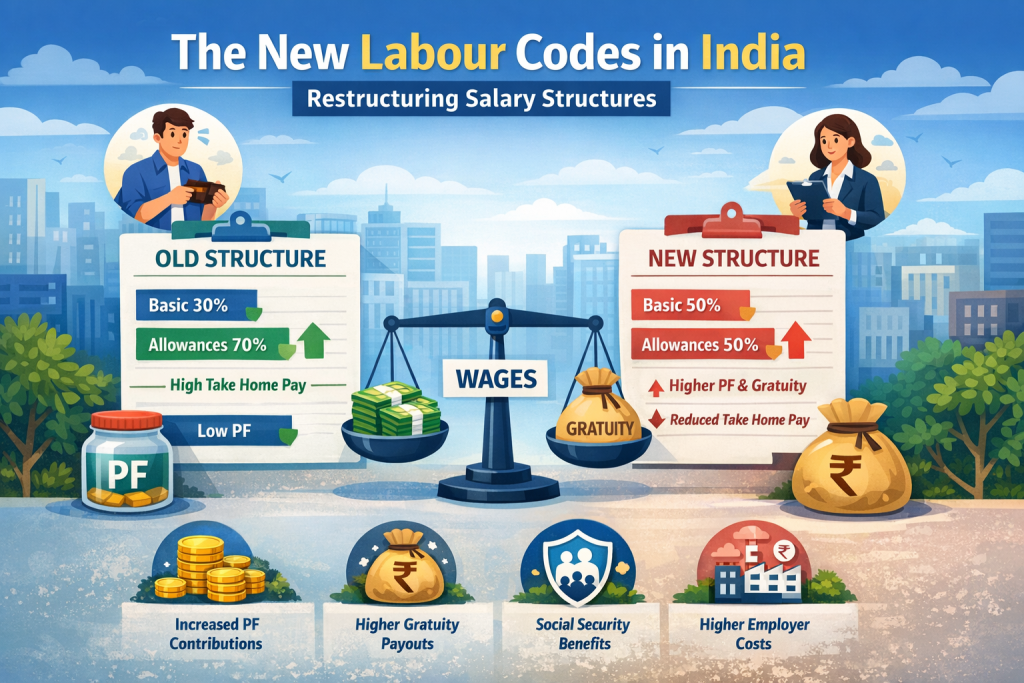
Earlier Salary Structure
- Basic salary: 30 to 40 percent
- Allowances: 60 to 70 percent
- Lower statutory contributions
- Higher take home salary
New Salary Structure
- Basic salary: Minimum 50 percent
- Reduced flexibility in allowances
- Higher statutory contributions
- Possible reduction in take home salary
Impact on Employees
Lower Take Home Salary
With a higher basic salary, PF contributions increase. This may reduce monthly take home pay.
Higher Retirement Savings
Employees benefit from increased PF contributions, leading to a stronger retirement corpus.
Improved Gratuity Benefits
Gratuity is calculated on basic salary. A higher basic leads to a higher payout.
Better Social Security Coverage
The new codes expand benefits to a larger workforce, including gig and contract workers.
Impact on Employers
Increased Cost to Company
Higher contributions towards PF and gratuity increase overall employee cost.
Need for Salary Restructuring
Existing compensation structures must be redesigned to comply with the new rules.
Compliance Requirements
HR teams must ensure accurate classification of wage components and maintain audit-ready records.
Impact on Cash Flow
Higher statutory payouts may affect short term cash flow planning.
Example of Salary Restructuring
Old Structure (CTC: ₹10,00,000)
- Basic salary: ₹3,00,000
- Allowances: ₹7,00,000
New Structure (CTC: ₹10,00,000)
- Basic salary: ₹5,00,000
- Allowances: ₹5,00,000
Result:
- PF contribution increases
- Take home salary may reduce
- Long term savings improve
Industries Most Affected
Highly Impacted
- IT and ITES
- Startups
- Consulting firms
- Manufacturing
Moderately Impacted
- Logistics
- BFSI
- Retail
Key Challenges for HR Teams
Salary Benchmarking
Balancing competitive pay with compliance requirements.
Employee Communication
Explaining changes in take home salary and long term benefits.
System Upgrades
Ensuring payroll and HRMS systems are aligned with new rules.
Vendor Coordination
Working with payroll and compliance partners for accurate implementation.
Actionable Strategies for Businesses
Redesign Compensation Structures
Maintain compliance while optimizing employee take home.
Focus on Total Rewards
Include benefits such as insurance, bonuses, and ESOPs to offset reduced take home.
Communicate Transparently
Build trust by clearly explaining the impact of changes.
Upgrade HRMS and Payroll Systems
Adopt reliable tools to automate compliance and calculations.
Conduct Regular Compliance Audits
Ensure all wage definitions and statutory contributions are accurate.
Conclusion
The new labour codes mark a major shift in India’s employment and compensation landscape. While businesses may face higher costs and employees may notice a short term impact on take home salary, the long term benefits are significant.
Organizations that adapt early will gain a clear advantage in compliance, employee trust, and operational efficiency.